

Zero Suicide Initiative Transforms Suicide Care
Suicide is an urgent and growing public health crisis. During Suicide Prevention Month in September, it’s important to remember the lives lost to suicide, acknowledge the millions who have experienced suicidal thoughts, and the many individuals, families and communities who have been impacted by suicide.
According to the Suicide Prevention Resource Center, suicide rates increased among both males and females in the U.S. from 2011 to 2021. In that time period, the total age-adjusted suicide death rate increased from 12.3 to 14.1 per 100,000 people. And according to the U.S. Department of Health and Human Services, more than 49,000 people in the United States died by suicide in 2022.
That’s one death every 11 minutes.
“For a long time, the thought behind suicide was there’s nothing we can do about it because we can’t change an individual’s actions, but research shows if we ask the right questions, do appropriate follow-up and complete safety plans with individuals, we actually CAN reduce the risk of suicide and the overall number of deaths by suicide,” says Aspire Director of Service Entry Kaitlyn Ervin.
Ervin is the chair of Aspire’s Zero Suicide Committee, a group of team members that leads Aspire’s participation in the Zero Suicide Initiative. It is based on the foundational belief suicide deaths for individuals under the care of health and behavioral health systems are preventable.
Inspired by healthcare systems that saw dramatic reductions in patient suicide, Zero Suicide began as a key concept of the 2012 National Strategy for Suicide Prevention and quickly became a priority of National Action Alliance for Suicide Prevention and, through the Suicide Prevention Resource Center, a project of Education Development Center.
Since 2014, ZeroSuicide.com has been an evolving source of free resources and open community support for systems taking on the challenge of Zero Suicide. For systems dedicated to improving patient safety, Zero Suicide presents an aspirational challenge and practical framework for system-wide transformation toward safer suicide care.
“There was trend of an increasing number of deaths by suicide, and one of our goals as an organization was to focus on reducing that number,” says Aspire Executive Vice President and Chief Transformation Officer Jim Skeel. “It felt like we needed to do something internally, and Zero Suicide was demonstrating success when nothing else was. They’re now at the epicenter of what works and what doesn’t, so it was an easy decision to get their guidance on implementing the Zero Suicide framework at Aspire.”
Zero Suicide Framework
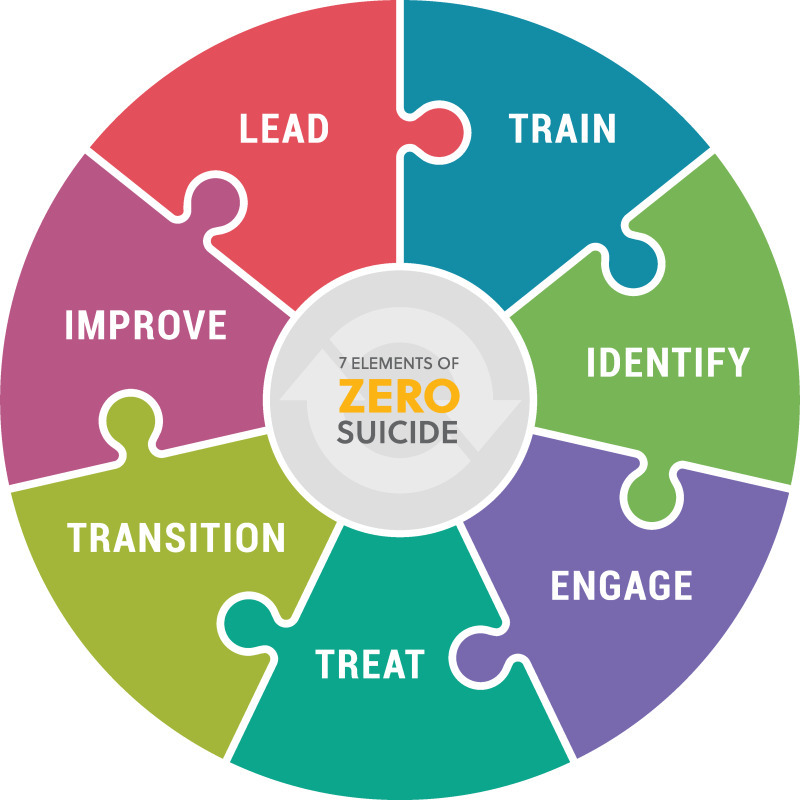
Aspire became a part of the Zero Suicide Initiative in 2015 and created an internal team to incorporate the seven elements that make up the Zero Suicide framework into the company’s systems of care to deliver safer, more effective care. The Zero Suicide Elements are:
Lead: Lead system-wide culture change committed to reducing suicides.
Train: Train a competent, confident and caring workforce.
Identify: Identify individuals with suicide risk via comprehensive screening and assessment.
Engage: Engage all individuals at risk of suicide using a suicide care management plan.
Treat: Treat suicidal thoughts and behaviors directly using evidence-based treatments.
Transition: Transition individuals through care with warm hand-offs and supportive contacts.
Improve: Improve policies and procedures through continuous quality improvement.
“When we first started down this path with Zero Suicide in 2015, we spent a lot of time with their leadership learning more about the Zero Suicide core values, including the commitment to being a learning organization dedicated to change that advances best practices in suicide care. We never stop trying to better ourselves and our care as an organization, improving how we serve our patients.”
“Zero Suicide is evidence based, everything from the tools and assessments to the way we contact people,” Skeel says. “And research demonstrates that it works.”
That’s why, since the conception of the Zero Suicide Committee, Aspire has recognized the importance of creating — and adhering to — a 90-day action plan. Examples of action items have been:
Develop an Initiatives page on our internal website so all staff have access to current efforts.
Review protocols and procedures related to the Zero Suicide Initiative to verify they are up to date and relate to all services lines.
Review ongoing data to help ensure we are assessing and safety planning in a timely and appropriate manner, in a way that is supporting the individual we’re serving.
“Suicide is a topic that can be scary to address, even for those of us providing services,” Ervin says. “At Aspire, we want to empower our staff to not only know we can help reduce the number of deaths by suicide but to understand how to have those conversations and become more comfortable discussing suicide with patients.”
Intervention and Suicide Prevention
Interactions with Aspire staff are a critical part of the patient experience, and one of the first ways any behavioral services patient is assessed is with the Columbia Suicide Severity Rating Scale (C-SSRS), a series of questions anyone can ask to help identify whether someone is at risk for suicide, determine the severity and immediacy of the risk and gauge the level of support the person needs.
“A key piece of this protocol is that we are using shared language,” Ervin says. “Staff don’t have to worry about if they are asking the right questions or saying the right things; you simply have to ask the questions and determine the score. Based on the scoring, it gives us a risk level, and next steps are determined from that level.”
Aspire created its “Clinical Care for Suicide Risk Policy” to “identify and outline the processes of our current clinical care guidelines, minimum training standards and related activities for addressing the care for people we serve who are identified as being at risk for suicide.” Part of the policy addresses Aspire’s periodic use of a Zero Suicide Workforce Survey to gather a snapshot of employees’ perceptions, training, competency and comfort in working with this population; the results are used to enhance Aspire’s training plans for employees.
“We know from the Workforce Survey there is an increased staff level of comfort dealing with suicide,” Skeel says. “We have a continuous training and retraining effort to make sure new staff members and new clinicians are trained appropriately, and therefore, there is more acceptance and understanding internally about suicide and a greater focus on compassion overall.”
“I was working at Aspire as a youth and adolescent therapist when we started the Zero Suicide Committee, and through my work I have seen the changes and progress we have been able to make,” Ervin says. “Now as a manager, it’s important to me to understand suicide prevention and how to support those individuals I am managing — and the Aspire staff as a whole — to increase the level of comfort with talking about suicide and providing the care needed to reduce the amount of deaths by suicide.”
Aspire’s adherence to the Zero Suicide framework has resulted in a 750% reduction in deaths by suicide in the last 10 years. And according to Skeel, that translates to 140 lives saved.
“Suicide is the worst possible outcome of mental illness,” Skeel says. “We have no ability to help someone after that. Before, we were just treating symptoms; now we are tackling this problem head on and being an active part of an individual’s care plan.”
“Aspire has been dedicated to helping individuals dealing with suicide risk; we are continuing to push through different stigma and make changes to improve suicide care,” Ervin says. “Suicide can affect anyone at any time, so it’s important to educate more people on what suicide prevention and care looks like. And if we learn the language and are more comfortable having the conversations, we can really make a difference.”


