

Team Health Equity Brings Together HOPE, Social Impact and Recovery Capital
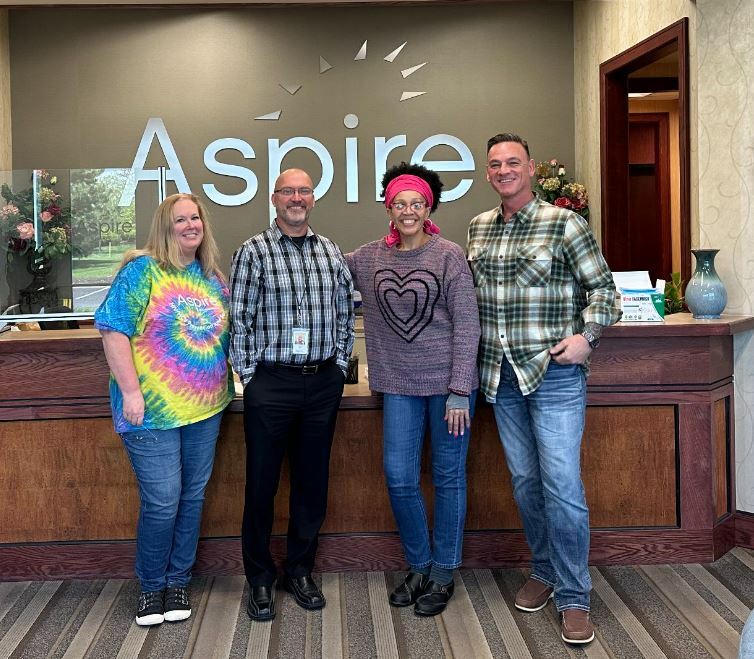
“Aspire has a duty to improve the health of the population we serve. Health equity is at the core of our mission, serving underserved communities with compassion,” says Aspire Culture Officer Dr. Gina Forrest.
That duty and mission led to the creation of a Health Equity Function at Aspire — bringing our work on recovery, social drivers of health and the infectious disease team together. Led by Forrest, Team Health Equity is a proactive initiative aimed at addressing the root causes of health disparities within the community we serve.
Team Health Equity comprises the Office of Recovery Capital, the Department of Social Impact (formerly Social Drivers of Health) and the Department of HOPE, which stands for Health, Outreach, Prevention and Education (formerly Infectious Disease).
“While Aspire was in the process of reorganizing our leadership structure, we wanted to dig into the roots of who we are with a more targeted approach to decreasing health inequities and helping those people who are trying to access care,” Forrest says. “These three areas have always been the boots on the ground and out in the community doing work, and to bring them together to be more strategically aligned will hopefully bring an even greater impact to those we are serving.”
One of the ways to create greater impact is through education, and Forrest says she will be encouraging those Aspire staff members in Team Health Equity to become certified community health workers (CCHW), proving they have a demonstrated foundational mastery of the community health worker (CHW) core competencies as defined both nationally and in the state of Indiana.
According to the Indiana Community Health Workers Association, a CHW is “a frontline public health worker who is a trusted member of and/or has an unusually close understanding of the community served. This trusting relationship enables the CHW to serve as a liaison/link/intermediary between health/social services and the community to facilitate access to services and improve the quality and cultural competence of service delivery. A community health worker also builds individual and community capacity by increasing health knowledge and self-sufficiency through a range of activities such as outreach, community education, informal counseling, social support and advocacy.
“Our team members already do so much work in the community — this additional education will support them with more knowledge, resources and training as they provide comprehensive services and advocate for individuals and communities throughout Indiana,” Forrest says.
In addition, Team Health Equity will be conducting a community health needs assessment in each of the counties Aspire serves to more clearly identify the different health needs of each area.
“Each county has different needs based on their social drivers of health,” Forrest says. “One county might need more employment assistance, and another might need more legal assistance. It’s important for us to look at each county and community we serve from a strategic lens. Who are we not reaching? We know we aren’t reaching everyone, so this assessment will help us better find the gaps and understand what we can do to help.”
A survey will be sent to the zip codes throughout the counties; there will also be focus groups and interviews done with key Aspire stakeholders, partners and advocates. From the data gathered, Team Health Equity will create a plan to begin to reduce any health inequities present.
Another goal of Team Health Equity is to form an internal health equity committee at Aspire.
“We want to ensure we are listening to all different perspectives from across the organization,” Forrest says. “Everyone has a role to play in helping decrease health inequities, and once we gather and review the data, we want to make sure whatever plan we put into place is evaluated by Aspire staff in all different departments with different voices and opinions. We want to be able to keep each other informed on our successes as well as where we might be struggling.”
Forrest also plans to take the message of Aspire and Team Health Equity to external audiences, including media outlets and the general public through a podcast focused on health equity topics from intercultural perspectives.
“The content won’t be too academic, so anyone can listen and learn. My goal is to bring education and awareness of these important topics to a wider group of people and lead them to actual systemic change.”


