Practice Management team works to facilitate integration
The position of Practice Manager has evolved dramatically as healthcare models have shifted. Originally known as the person who handled the administrative side of a doctor’s practice, it’s become an increasingly important role in facilitating a holistic model of care that looks at the entire person, and not just their symptoms.
In its modern form at Aspire Indiana Health, the PMs act as the front line in achieving our goal of being a “whole health” provider with fully integrated care between primary medical and behavioral health, says Donna Tocco, one of the original practice managers who currently oversees the Carmel clinic. The PM position was introduced to Aspire nearly three years ago, originally focusing just on the behavioral health side and integrating with primary care at the end of 2019.
“It’s the PM’s responsibility to coordinate all of those different clinical areas along with the support associates,” Tocco says. “Each area such as medical staff or behavioral staff have a clinical manager and or director who is the person who gives them support on their expertise clinically. And it’s the practice manager who coordinates all of that from an operational perspective to make sure everything flows easily for the patients.”
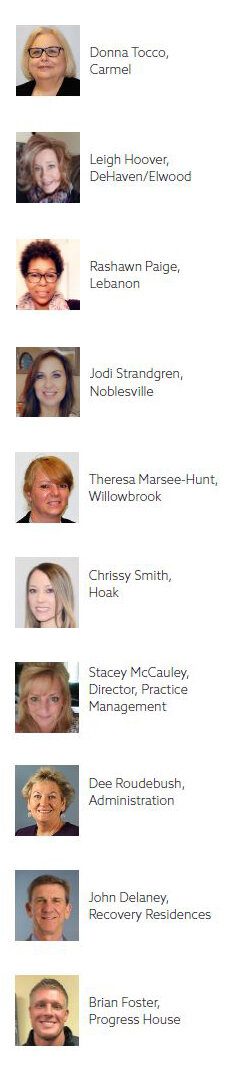
In addition to Tocco the current PM team includes Rashawn Paige, Lebanon clinic; Jodi Strandgren, Noblesville; Leigh Hoover, DeHaven and Elwood; Theresa Marsee-Hunt, Indianapolis; Chrissy Smith, Hoak; and Stacey McCauley, Director of Practice Management. Brian Foster, Director of Operations at Progress House, fills a similar role there.
“My role as a practice manager is to help with the business side of Aspire, while managing the practice as a whole. I get to collaborate with the clinical manager and discuss process changes that will help our staff to continue to be successful,” Paige says.
“As a practice manager, we are responsible for running and maintaining the workflows of the outpatient office. We collaborate with several different people in management due to the integration of Primary Care and Behavioral health to maintain the integrity of our staff,” Strandgren says.
Dee Roudebush, Chief Administrative Officer and a former practice administrator herself, says the PMs work to ensure consistent, standardized care practices happen at every Aspire location. They also look for efficiencies and process flow improvements. In the past practice managers came from the “business side” of healthcare, but increasingly more have clinical experience as well.
“Having a clinical background helps a PM understand the workflows to better support the providers and prescribers. Billing experience is a must for a PM as they are in charge of the beginning of the revenue cycle,” Roudebush says.
“We have the knowledge of what is needed for the practice to be successful as well and profitable. We are here to support the clinical team so they can perform at their level of clinical expertise. With our background in operations and billing, we can provide guidance and support to the practice so it can be successful.,” Hoover says.
“My job doesn't feel like a job most days. In fact, I enjoy coming to work because I get to focus on being of service to people that need my help,” Foster says.
“Being a practice manager is like being a housewife -- no one quite understands or appreciates exactly what they do all day... until they stop doing it!” McCauley says.