

New location, renewed sense of purpose for Kids Talk
Kids Talk Child Advocacy Center is now in its ninth year of providing Madison County children a safe place to talk about abuse or neglect they may have experienced or witnessed. In that time they’ve helped more than 4,000 families begin the healing process while assisting local law enforcement in prosecuting criminals.
Now, a new era has dawned with a renewed sense of purpose and direction. Kids Talk has added sex trafficking and protection of elder abuse victims and vulnerable adults to its mission. And they renewed their in-person prevention educational programs in Madison County schools, which had been suspended during the COVID pandemic, to let children know when and how to let an adult know about something they’ve experienced.
The evolution of Kids Talk, a program of Aspire Indiana Health, is also marked in one very tangible way: their recent move to a new location in downtown Anderson, 814 Central Avenue.
Denise Valdez, executive director of Kids Talk, says the new location provides a more modern, calming space in a safer neighborhood for families to bring their children for very delicate conversations.
Despite all these changes, the Aspire team at Kids Talk has remained remarkably stable during its existence.
“Each person plays an important part in the team. They are the reason the Kids Talk team does an amazing job at what they do!” Valdez says.
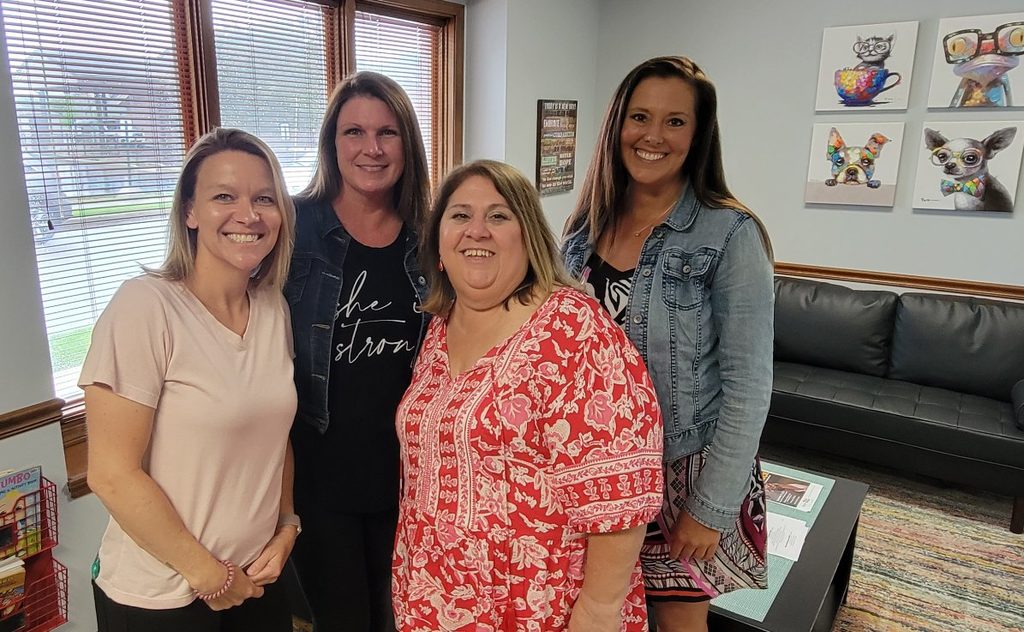
Becky Oldham is one of the individuals on the Kids Talk team. Becky’s primary role is as a victim advocate and forensic interviewer. Along with this title she is also a manager overseeing the daily operations and staff oversight.
Julie Coon is the primary forensic interviewer. Although all of the individuals on this team are cross-trained to perform in all Kids Talk programs, this is her primary focus and contribution to the team.
Amy Bounds fulfills the role of victim advocate. Along with this title she is also the prevention program coordinator, and recently finished her training and certification to provide forensic interviews as well.
Each individual plays a part in the multidisciplinary team, which consists of law enforcement, prosecution, Indiana Department of Child Services (DCS), forensic interviewers, victim advocates, mental health and medical services. All members of the Kids Talk team have specific qualities that make the team successful. “We are all super compassionate. We are all passionate advocates for children,” Valdez says.
There are three programs at Kids Talk. The core program is forensic interviewing. The forensic interviewing process happens when kids are reported as abused or neglected or are witnesses to violent crimes. Rather than being interviewed by multiple agencies for investigative purposes, they are brought to Kids Talk. The kids that are interviewed range from ages 3-17.
During the interview process, there is only one forensic interviewer in the room with a child. While the interview is being conducted, it is being observed live via video feed and recorded in another room by detectives, prosecutors and DCS. Interviewers wear discreet earpieces and carry a radio that allows investigators to speak directly in their ear in the event an interviewer doesn’t ask a question that needs to be presented to the child.
In cases where children disclose abuse or criminal neglect, Kids Talk facilitates monthly case review with the multidisciplinary team in order to share information, receive investigation updates and ensure seamless delivery of services to children and their caregivers.
The second program is victim advocacy. This includes talking to caregivers to prepare children for upcoming visits and answer any questions they have. During the visit to Kids Talk, advocates speak with caregivers to assess needs of the child and family, answer questions about the investigative process and victims rights, provide brief crisis debriefing if needed, educate caregivers on short and longer term impacts of trauma without intervention, encourage therapeutic intervention and facilitate referrals to support services.
In cases involving imminent threat to children and caregivers, Kids Talk advocates will help the family with protective order applications. Kids Talk advocates also provide follow up contacts to caregivers in the weeks and months following a visit to answer questions, encourage therapeutic interventions when needed and intervene with investigative agencies.
The third program is the Kids Talk prevention program, divided into two parts. The first is called Body Boundaries. This program is for younger elementary age students, generally kindergarten through third grade. It focuses on teaching correct anatomical names for private body parts and five essential body safety rules. It includes classroom instruction and body safety rules posters for the classroom. They are:
- No one can touch my body without my permission.
- No one can look at my body without my permission.
- No one can take pictures and videos of me without my clothes on.
- We do not play games or keep secrets about our private body parts.
- If someone breaks one of the rules, I will tell a trusted adult.
“We teach them that if anyone breaks one of these rules, the new rule is they need to tell an adult they can trust. A part of the program is having the children identify individuals who they can trust both in school and at home,” Valdez says. “At the end of the program the students fill out a small piece of paper indicating whether they need to talk to someone about what they have learned. Our personnel will speak privately to each child who indicates that they would like to speak to someone to assess whether the child has a concern that needs to be addressed.”
For older kids, generally starting around fourth grade, there is the Staying Safe in the Digital World portion of the prevention program. Throughout this program they talk to students about safety when they’re online, gaming or participating in any other digital activities.
Once in middle school, students begin having conversations about sexting, which is text messaging that includes explicit language about sex and/or exchanges of intimate photos or video. The Kids Talk team talks about the importance of consent and the long-term implications of having explicit material about yourself floating around the web, which could potentially impact things like college applications, scholarships and even job prospects.
“We make them start thinking about what is okay and what's not okay. Sexting is an epidemic in schools. It's not just here, it's everywhere!” Valdez says.
Since Kids Talk opened, child abuse cases filed have more than tripled, with approximately 80 currently sitting in the courts awaiting trial.
Last year Kids Talk staff went through training to expand their scope to two other populations: sex trafficking victims and elder abuse victims or vulnerable adults with cognitive disabilities. Indiana is a major crossroads of child sex trafficking owing to its geographic location. While the majority of child sex trafficking cases in Madison County are perpetrated by the families of children, Kids Talk staff have the ability to identify and respond to familial cases as well as federal cases which tend to involve children trafficked in from other areas.
In cases involving elderly people and adults with developmental disabilities, Kids Talk staff are trained and certified to interview people with special needs, including non-verbal victims.
Valdez says this new more expansive mission will have a big impact on the Madison County community – not only to help these specific victims, but to create an atmosphere where everyone feels less stigma about seeking help when they encounter abuse.
“It can be intimidating for victims, especially the older they get, to think about going and speaking with investigators. If they know there's a place specifically designed for victims where they’ll be getting support from people who are especially trained in the trauma involved with victimization, they're going to feel more comfortable discussing things that have happened to them,” she says.
Stand Up for Kids set for Sept. 10
Kids-Talk is entirely grant and fundraising effort funded. Fundraising opportunities include donations and our annual comedy night On September 10, 2022 comedian Joe Deuce will be headlining at the Paramount Theatre Ballroom! Please check out funny4kidz.givesmart.com for more information and tickets.


