
Emotional Service Through Property Maintenance
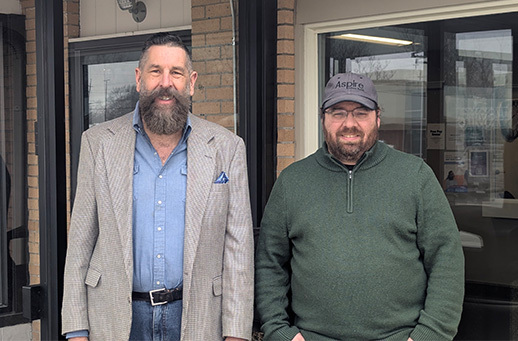
Aspire Indiana Health’s Facilities Team has a heart for service. The 15-member team believes in and supports each other like a family, dedicated to providing Aspire clients and staff with what they endeavor to be some of the best facilities in the community mental health world.
Aspire owns or leases nearly 70 properties — used for health centers, supported group homes, independent apartment living complexes, single family homes and apartments dedicated to individuals in Aspire’s recovery continuum. Those properties span Aspire’s coverage of Hamilton, Marion, Madison and Boone Counties — and now include the newest properties in Shelby and Hancock Counties as a result of Aspire beginning services in those counties as the newly designated Community Mental Health Center (CMHC).
Maintaining those properties is Aspire’s Facilities Team, led by Senior Director of Facilities David Wildman and Manager of Facilities Brian McCarthy. Aspire’s Facilities Team includes: Supervisors Dwaine Jackson and Joe Leising, maintenance technicians Danny Cross, Mike Garland, Christian Gaspard, Gregory Goff, Michael Holman, Larry Hutton, James Liebrecht, James McCartha and Leonard Padgett, along with mail carriers John Iterman and Jim Kartholl.
“We have built a team where each individual feels comfortable to have a voice,” McCarthy says. “It’s about our whole team working together to come up with solutions.”
Staying on Track with Requests
How does the Facilities Team stay on track with maintenance requests? They use a work order ticketing system — one that brings in an average of 430 tickets a month. And no two tickets are the same. It may be something as simple as a burned out lightbulb or as complex as a makeover of one of the HUD apartments.
As the maintenance requests come in, they are divided into three categories: life/safety — which is typically some kind of emergency, normal tickets and those that are capital projects.
“If it’s a life/safety issue, per Aspire’s policies, we have 72 hours to take care of it,” McCarthy says. “That 72 hours is just the first step to put a bandage on it. It could be a water leak, fire or a more urgent situation.”
The level two, or normal, tickets range from a wiggly door handle to a lightbulb replacement, and those projects are typically completed in 10-20 days. Then, the level three tickets are larger capital projects that can take weeks to complete.
“Some of those level three tickets are several projects in one property — a bathroom remodel, the floors need new carpeting and repainting the entire space,” McCarthy says.
And many of the federal guidelines require extremely high standards — a good challenge for the team to both meet… and exceed.
“Even though Aspire is both a Medicaid and Medicare provider, we want our spaces to have the look and feel of a private practice,” McCarthy says. “Just because someone is on Medicaid does not mean they have to come to a second-class facility. There’s the dignity that comes from a first-class, high-quality facility we want to have in place for everyone who visits an Aspire property.”
A Team Effort
The maintenance of Aspire’s properties is a job Wildman and McCarthy can’t handle alone. They look to their team members to be actively involved and accountable for those buildings and facilities they are in charge of. Each team member is assigned to certain buildings, but there is a proactive willingness to jump in and lend a helping hand where needed.
“We want the individuals on our team who have that level of independence and engagement in their job,” Wildman says. “We can’t be everywhere to see everything, and they are the ones who are seeing the evolution of these buildings and have firsthand knowledge of what’s going on.”
Plus, it gives each team member the chance to build relationships with the staff at that particular building — getting to know the people on an individual level and developing that rapport.
“There is a level of trust between the building staff and the facilities team member,” McCarthy says. He adds that Supervisor Joe Leising articulated the statement, “The clients are why we are here. We can’t take care of them physically or with their mental or emotional needs, but we can take care of their environment and how the buildings and facilities look, and if our clients and patients feel good where they are sleeping, living or receiving care through Aspire, then they are going to feel better as a whole.”
And Aspire’s whole health focus is one the facilities team takes seriously.
The Facilities Family
The Aspire Facilities Team is more than just team members — they are family. They care for each other on a personal level, and it’s a bond that is formed as a team and has deepened and widened to the clients and staff they care for in each of the Aspire properties.
“There is a level of emotional service that goes into this job,” Wildman says. “It’s knowing we’re doing something that may make the world a little bit better of a place in some way for someone.”
“We love the clients, and the clients love our team,” McCarthy says. “That’s why we are here is to make a difference in their lives.”