

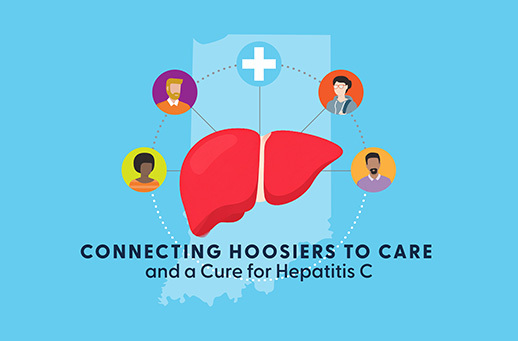
Connecting Hoosiers to Care and a Cure for Hepatitis C
Hepatitis C is the most common blood-borne pathogen in the United States, killing more than 10,000 Americans and leading to billions of dollars of healthcare costs every year. October is Liver Cancer Awareness Month, and having hepatitis C is a significant risk factor for adult liver cancer.
Hepatitis C is transmitted when blood from someone who is infected enters the body of another person. While sharing needles and syringes for injecting drugs as well as unprotected sexual contact with someone living with Hep C puts an individual at higher risk, there are also other ways to contract the virus such as using someone else’s toothbrush, nail clippers, or razor.
“Individuals are sometimes uninformed that Hep C can be spread from sharing normal everyday items,” says Aspire Indiana Health Hepatitis C Coordinator Jayne Weir. “I take every opportunity I can to explain and make them aware of how easy it is to get.”
In 2019, Indiana ranked first in the nation for the rate of reported acute hepatitis C (HCV) cases, according to the Centers for Disease Control and Prevention (CDC). And the Hoosier state also showed higher-than-average rates in other recent years, such as ranking fifth in the U.S. for acute HCV cases in 2020 and ninth in 2021.
“We’ve had Hep C program funding from the Indiana Department of Health for about 10 years, but the funding really only covered kits for rapid Hep C antibody testing,” says Aspire Team HOPE Director Julie Foltz. “At that point, when someone got a reactive result, we encouraged them to visit their healthcare provider, but we couldn’t do much more for them. We began to see more and more reactive cases — but had no services available. It wasn’t until a few years later that the state started to provide more funding for case management and care coordination.”
Connect to Cure Initiative
The State of Indiana began the statewide initiative called Connect to Cure in June 2023. This initiative launched with funding from the Indiana Department of Health’s Health Issues and Challenges grant program to provide hepatitis C testing, care coordination and support across 19 regional sites in the state.
“It matches so closely with what we were already doing for people living with HIV through the Ryan White program, that when the state rolled out Connect to Cure, it was a good fit for us,” Foltz says.
In 2024, 2,798 Hoosiers were newly reported with hepatitis C. It is estimated that more than 40,000 Hoosiers are living with hepatitis C, according to HepVu.org. One-third of those living with Hep C don’t know they have it because many people don’t have any symptoms. Testing is the only way to know for sure.
“We have a team out in the community who does the testing in 32 counties throughout Indiana — going to jails, health departments, recovery shelters and soup kitchens,” Foltz says. “And now, when we have an individual who gets a reactive test, we can link them to our Hepatitis C coordinators to connect them with resources and help them get treatment.”
Fighting Stigma with Advocacy
The Connect to Cure program has 18 care coordinators in Indiana, and two of them are Aspire employees. Jayne Weir and Abby Vonderschmitt offer their services in 17 counties between the two of them — services that are free of charge to the clients they work with. Their goal is to make contact with individuals after they have received a reactive (or positive) HCV antibody test and walk with them through their journey toward treatment.
Ninety-five percent of those living with hepatitis C can be cured.
“I will meet my clients where they’re at — both literally and figuratively,” Vonderschmitt says. “I have met people in jail, on the sidewalk, anywhere they need in order to get them the support and services they need. I like to meet with my clients in person as much as I can to build that relationship and rapport with them, and to show them I’m serious about their health.”
Not being serious about their healthcare is often part of the stigma linked to people using drugs, especially those who are actively using substances. And that is why Weir and Vonderschmitt often have trouble finding primary healthcare providers to serve their clients with HCV.
“I have worked really hard to find primary care providers who will work with and treat people with hepatitis C, because not everyone will,” Vonderschmitt says.
“It’s the provider’s choice whether they want to treat someone or not, and there is still a lot of stigma around hepatitis C — especially when the primary risk factor is injection drug use,” Foltz says. “But there is no reason to withhold treatment from someone just because they use drugs. Everybody is worthy of treatment.”
“Many of these people are in survival mode,” Weir says. “They’re doing what they can to meet their basic needs to stay alive. Some of them may know they have hepatitis C and just don’t have the means to get to an appointment. They are just trying to live, and that’s why we come alongside them and support them, whether that’s giving them a ride or connecting them to other resources.”
Treating is Prevention
The treatment regimen for Hep C involves taking a combination of medications for eight to 12 weeks, depending on the medicine and the individual.
“Often, these individuals are looked at as ones who will not take their medication,” Weir says. “And I’ve not had one client yet who didn’t take their medicine. Not one.” One untreated person could potentially transmit HCV to 25 other people. So by getting treated, you’re helping yourself, but you’re also greatly reducing the risk of transmitting the virus to others.
A cure is possible — and the Aspire team is here to help. Vonderschmitt says when she meets with her clients, she also lets them know about Aspire’s other programs that are available to them.
“Even though we are helping to treat them for hepatitis C, I always think of them as a whole person and what other services they might need, whether that’s medical or behavioral services, housing, employment or other special needs.”
Foltz says Weir and Vonderschmitt are both fierce advocates for getting treatment for their clients and showing up with love through their actions.
“This is really just about loving other human beings, and that’s what we do,” she says. “We accept them as they are, and we help them understand they are worthy of care and treatment. We let them know it’s OK to love themselves, and one way to show love is by taking care of their health and wellbeing.”
To learn more about hepatitis C and help break down the stigma associated with it, please visit: https://www.in.gov/health/hiv-std-viral-hepatitis/files/IDOH-Hepatitis-C-Fact-Sheet-2023-EN.pdf.


